Choosing the right domain name is an important part of building a recognizable online identity.
Additionally, EU Domain Names help eligible businesses, organizations, and individuals with a connection to Europe.
They provide a clear way to establish that regional presence.
A website ending in .EU signals a European focus. Using EU Domain Names can help present a pan-European presence for companies that operate across several European countries.
HostRite currently offers eligible customers the ability to register or transfer EU Domain Names from $9.00 per year, with management tools available through its online Domain Manager.
What Are EU Domain Names?
EU Domain Names are web addresses that use the official .EU domain extension. The extension is associated with the European Union and is managed by EURid, the official registry responsible for .EU domains.
Examples of possible EU Domain Names include:
- yourcompany.eu
- yourstore.eu
- yourproject.eu
- yourname.eu
- yourorganization.eu
The extension can be used for many types of websites, including business sites, online stores, nonprofit organizations, professional portfolios, blogs, educational projects, and community initiatives.
Because .EU represents a broad European identity, it can be particularly valuable for organizations that work across national borders.
Who Can Register EU Domain Names?
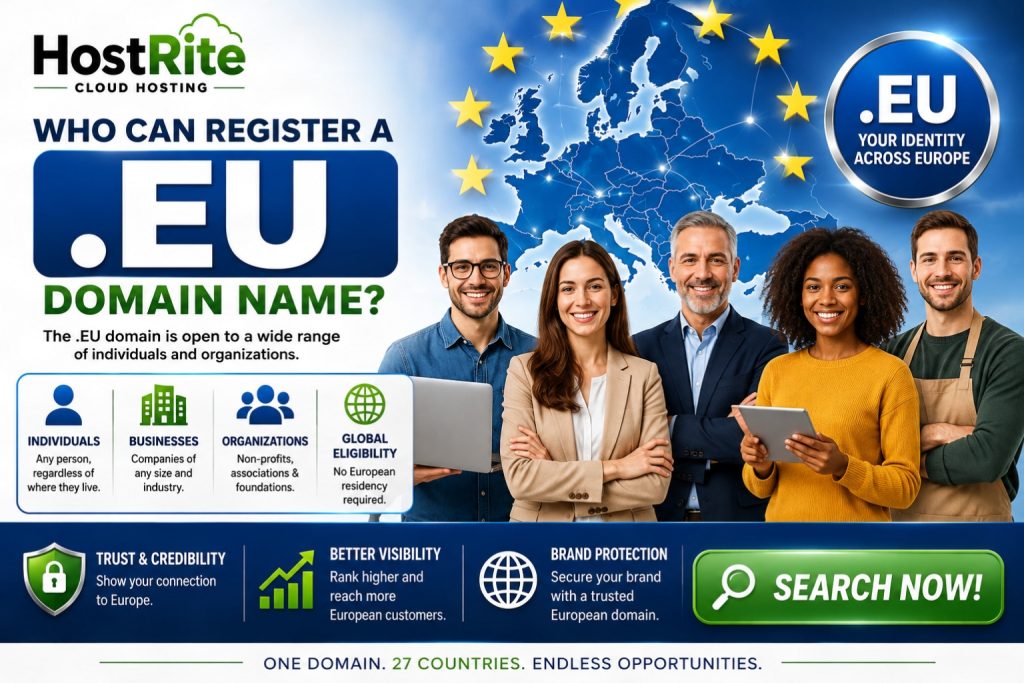
Registration is subject to eligibility rules established by the .EU registry. Unlike unrestricted extensions, not everyone automatically qualifies to register a .EU domain.
A registration may generally be requested by:
- A citizen of an EU member state
- A citizen of Iceland, Liechtenstein, or Norway
- An eligible citizen living outside those countries
- A resident of an EU member state, Iceland, Liechtenstein, or Norway
- A business established in one of the eligible countries
- An organization established in one of the eligible countries
Applicants must provide complete and accurate registration information. EURid may also request documents or other information to verify eligibility.
Before placing an order, make sure the person, company, or organization listed as the registrant meets the current requirements.
Why Choose EU Domain Names for Your Website?
Establish a Recognizable European Identity
The main advantage of a .EU address is that it clearly communicates a connection to Europe.
Visitors can immediately see that the website serves a European audience, represents a European organization, or conducts business within the region. This can strengthen the identity of companies operating across more than one European country.
EU Domain Names may be suitable for:
- European e-commerce businesses
- International companies with European offices
- Tourism and travel services
- Consultants serving European clients
- Trade associations
- Educational institutions
- Nonprofit organizations
- Community projects
- Technology companies
- Professional service providers
Support Cross-Border Business Growth
A country-code domain such as .DE, .FR, or .IT can be effective when a company primarily serves one country. However, a .EU domain can be a better fit when the organization operates across several European markets.
For example, a company serving customers in Germany, France, Spain, and Italy can use one primary .EU website while creating separate language or country sections for each audience.
This provides a consistent brand identity without requiring the company to operate a completely separate main website for every country.
Improve Domain Name Availability
Many short and desirable .COM domains have already been registered. A .EU extension may offer more opportunities to secure a concise address that closely matches your company, product, service, or organization.
A shorter domain is generally easier to:
- Remember
- Type correctly
- Share verbally
- Display in advertisements
- Add to printed materials
- Use on social media
- Include in a professional email address
The availability of a particular name can change at any time, so it is wise to register an appropriate domain once you are ready to use it.
Build a More Memorable Brand
A domain extension can become part of the brand itself.
A well-chosen .EU name can help a business present itself as modern, professional, and connected to the European market. The extension may also make the full web address more distinctive than a long or complicated alternative.
The best domain name should still be simple, relevant, and easy to understand. The extension works most effectively when paired with a strong business or project name.
Create Professional Email Addresses
EU Domain Names can also be used to create branded email addresses, such as:
- contact@yourcompany.eu
- mailto:sales@yourcompany.eu
- mailto:support@yourcompany.eu
- billing@yourcompany.eu
- mailto:yourname@yourcompany.eu
A domain-based email address usually appears more professional than a free personal email account. It can also reinforce the company name each time an employee communicates with a customer.
Are EU Domain Names Good for SEO?
A .EU domain can help users understand the geographic focus of a website, but the domain extension alone does not guarantee better rankings in Google or Bing.
Search visibility depends on the overall quality and usefulness of the website. Important factors include:
- Helpful and original content
- Fast page-loading times
- Mobile-friendly design
- Clear website navigation
- Descriptive page titles
- Relevant internal links
- Quality backlinks
- Accurate business information
- Secure HTTPS connections
- Appropriate language and regional targeting
A company serving multiple European markets should create useful pages for each important audience. This may include local language content, country-specific service information, regional pricing, and relevant contact details.
The goal should be to provide a useful experience for European visitors rather than simply repeating geographic keywords throughout the site.
How to Choose the Right .EU Domain Name
Keep It Short and Simple
Short domains are easier to remember and less likely to be entered incorrectly.
Avoid unnecessary words that make the address longer without improving its meaning.
Make It Easy to Spell
Choose a name that customers can spell after hearing it once.
Complicated spellings may cause visitors to enter the wrong address or send email to the wrong domain.
Avoid Unnecessary Hyphens and Numbers
Hyphens and numbers can make a web address more difficult to explain verbally.
Use them only when they are already an important and recognizable part of the brand.
Consider Multiple European Languages
Europe is a multilingual market. A name that sounds appropriate in one language may have an unintended meaning in another.
Before registering, review the proposed name in the languages spoken by your main audiences.
Check for Existing Trademarks
Domain availability does not automatically mean the name is legally safe to use.
Check relevant trademark databases and business records before registering a name that may be associated with another company or organization.
Think About Long-Term Growth
Select a domain that will continue to make sense as the business expands.
A name tied too closely to one product, city, or temporary promotion may become limiting later.
How to Register EU Domain Names Through HostRite
The registration process is straightforward.
Step 1 — Search for Your Preferred Name
Use the HostRite domain search tool to check whether your preferred .EU domain is available.
Try a few suitable alternatives in case your first choice has already been registered.
Step 2 — Confirm Your Eligibility
Make sure the registrant qualifies under the current .EU rules.
Use the real contact details of the eligible individual, business, or organization that will own the domain.
Step 3 — Select the Registration Period
Choose the available registration term that best meets your needs.
Longer registration periods can reduce the risk of an unexpected expiration, although renewal settings should still be checked regularly.
Step 4 — Review the Order
Carefully confirm the spelling of the domain before completing the purchase.
Domain registrations generally cannot be corrected simply by editing the name after the order has been processed.
Step 5 — Connect the Domain to Your Website
After registration, update the domain’s nameservers or DNS records so it points to your web hosting account. If you are hosting your EU domain on a plan from Hostrite your EU domain will be setup for you by us.
You can also configure email, redirects, and other services associated with the domain.
Managing EU Domain Names with HostRite
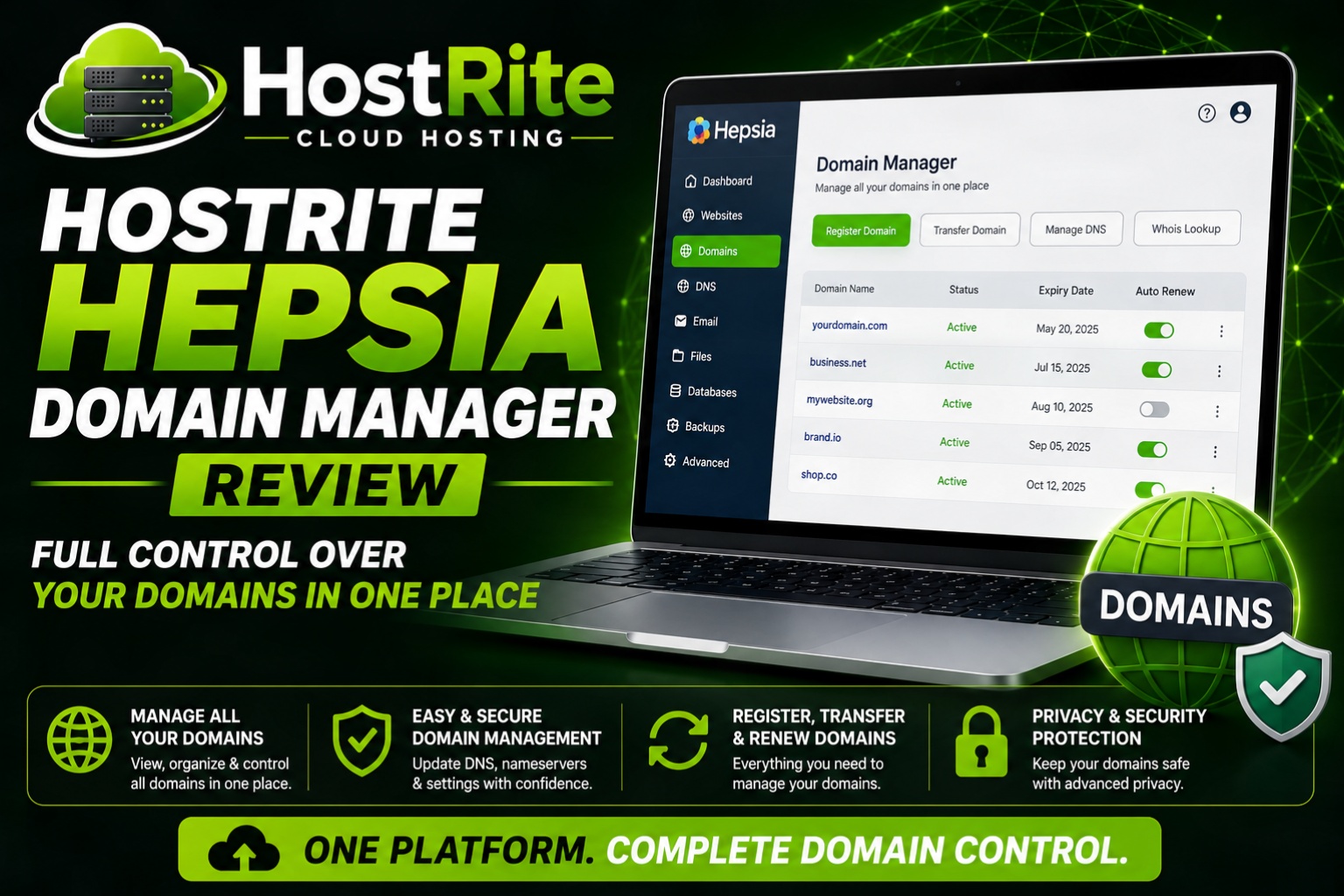
HostRite provides access to an online Domain Manager for controlling important domain settings.
- Update nameservers
- Edit DNS records
- Change contact information
- Configure URL forwarding
- Create custom DNS entries
- Connect the domain to web hosting
- Manage renewal settings
- Review domain status information
Keeping these settings organized is essential because the domain may control both the website and business email.
Transferring an Existing .EU Domain
Businesses that already own a .EU domain may be able to transfer it to HostRite.
A transfer will generally involve:
- Confirming that the domain is eligible for transfer
- Checking that the registrant information is accurate
- Obtaining the required authorization information
- Starting the transfer through the new provider
- Approving any confirmation requests
- Reviewing the DNS settings after the transfer
Before transferring a working domain, save a copy of all nameservers and DNS records. This can help prevent interruptions to the website or email service.
How to Protect Your .EU Domain
A domain name is an important digital asset. Losing access to it can interrupt your website, email, customer communication, and online sales.
Use these security practices:
- Create a strong and unique password
- Enable two-factor authentication when available
- Keep registrant information current
- Maintain access to the registrant email address
- Enable automatic renewal
- Review expiration notices carefully
- Limit account access to trusted users
- Monitor unexpected DNS changes
- Watch for fraudulent renewal invoices
- Keep payment information current
Domain security should be part of your overall website security plan.
Frequently Asked Questions About EU Domain Names
Can anyone register EU Domain Names?
No. The registrant must meet the official eligibility requirements. Eligible applicants generally include qualifying citizens, residents, businesses, and organizations connected to the European Union, Iceland, Liechtenstein, or Norway.
Can an EU citizen living outside Europe register a .EU domain?
Yes. A qualifying citizen can generally register a .EU domain regardless of their current place of residence.
Can a U.S. company register a .EU domain?
A company established only in the United States generally would not qualify by itself. It may qualify if it has an eligible business establishment in the covered region.
Registration information must identify the actual eligible domain holder.
Can I use a .EU domain for an online store?
Yes. A .EU domain can be used for an e-commerce website, provided the registrant meets the eligibility requirements.
It may be especially useful for stores selling products or services across several European countries.
Can I use a .EU domain with any web hosting company?
Yes. The domain can normally be connected to any compatible hosting provider by changing its nameservers or DNS records.
Can I transfer my .EU domain later?
Yes. A .EU domain can generally be transferred between participating registrars, subject to the applicable transfer rules and verification requirements.
Are EU Domain Names good for international businesses?
They can be a strong choice for international businesses that have an eligible European presence and want to emphasize their connection to the European market.
Final Thoughts on EU Domain Names
Additionally, EU Domain Names can provide eligible businesses, organizations, and individuals with a professional and recognizable European web identity.
They are particularly useful for companies operating across several European countries, organizations working on cross-border projects, and individuals who want an address that reflects their European connection.
A strong .EU domain should be short, memorable, legally appropriate, easy to spell, and flexible enough to support future growth. It should also be protected with accurate registration information, secure account access, and dependable renewal settings.
When combined with reliable hosting, useful content, professional email, and a well-designed website, a .EU domain can become a valuable foundation for building a successful European online presence.